
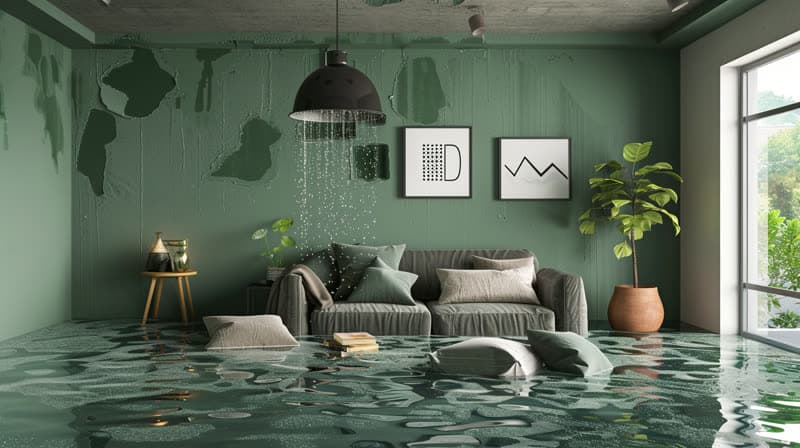
Every winter the same claim arrives in quantity. A cold snap, a pipe in an unheated space, and then a thaw, which is when most people actually find out. The water has been running for hours before anyone notices, and by then it is through a ceiling.
What follows is usually a reasonable claim, and it is also one where the gap between what people assume is covered and what is actually covered is unusually wide. This guide is about that gap. For what to do in the first hours, read our guide to the first 48 hours after an escape of water, and the practical questions are answered on our burst pipe and water damage page.
The distinction that decides most of it
Policies draw a line between the damage the water causes and the thing that failed.
The damage caused by escaping water is what the policy is there for. Soaked ceilings and plaster, ruined flooring, damaged furniture and contents, and the drying and reinstatement work that follows. That is the substance of a typical claim and usually the large majority of its value.
The failed pipe itself is a different matter. Repairing or replacing the section of pipe that burst is often treated as maintenance rather than insured damage, and it is frequently not covered. People are regularly surprised by this, and it is worth understanding before the claim rather than during it.
Trace and access
This is the part of cover most people have never heard of and most need.
When water is coming from somewhere unknown, somebody has to find it, and finding it often means lifting floors, opening walls or taking up tiling. Trace and access cover pays for that investigative work and for putting right what had to be disturbed to do it.
It matters because without it you can be in the position of having the water damage covered while the cost of finding the leak sits with you. Policies vary considerably in whether they include it and in what limit they put on it. It is worth checking your own schedule for the phrase specifically.
Where the leak has not yet been located, trace and access and leak detection work can continue independently while the wider claim is being dealt with, which is usually the sensible order to do things in. Our leak detection partners page covers that side of it.
Alternative accommodation and the losses people forget
If the property cannot reasonably be lived in, the cost of staying somewhere else is often recoverable under the policy.
This is one of the most commonly missed heads of claim. People move in with family, absorb the cost themselves, and never think to claim it, which quietly reduces the settlement by whatever it cost them. The same applies to professional cleaning, debris removal and other losses that follow directly from the damage rather than being the damage itself.
Whether it applies, and up to what limit, depends on your policy. The point is simply to look, because nobody else is going to raise it for you.
Frozen pipes, and the exclusion that catches people
Here is where winter claims most often run into difficulty.
Many policies contain conditions about unoccupied properties during cold weather. The usual shape is a requirement to keep the heating on at a minimum temperature, or alternatively to drain the system down, if the property is going to be empty for a stated period. The length of that period and the temperature vary between policies.
If a property was left empty over Christmas with the heating off, and a pipe froze and burst, the insurer may rely on that condition. This is the single most common reason a winter burst pipe claim is challenged or declined.
So the practical advice, which costs nothing, is this: before you go away in winter, read the unoccupancy condition in your own policy and do what it says. And if you are already in a dispute about one, the wording of that specific condition is where the argument will be won or lost, so it is worth getting it looked at properly.
Gradual leaks are not the same as a burst
A pipe that bursts is a sudden event. A joint that has been weeping behind a wall for two years is not, and policies treat the two very differently.
Damage caused gradually, over time, is commonly excluded. The difficulty is that a slow leak often presents exactly like a sudden one, because the visible damage appears all at once when a ceiling finally gives way. Establishing which it was becomes the central question of the claim, and it is a technical argument rather than an obvious one.
This is one of the situations where early, accurate evidence matters most, and where having someone prepare the claim properly tends to make the difference.
Where it is worth getting help
A modest, uncontested burst pipe claim can be handled by most people without assistance. The ones worth getting help with are the larger and the contested ones:
- Significant damage across several rooms
- A property that cannot be lived in
- A claim where the insurer is relying on an unoccupancy condition
- A claim where the insurer is arguing the leak was gradual rather than sudden
- A claim that has simply stopped moving
We are loss assessors acting for policyholders. We prepare and present the claim, deal with the insurer and their loss adjuster, and handle the negotiation on your behalf. There are no upfront fees, and our claims process explains how it works.
If a pipe has gone and you are not sure what your policy actually covers, get in touch. It is a quicker conversation than most people expect.
This article is general information about how home insurance claims work in the UK. It is not advice on your individual claim, which will turn on your own policy wording and circumstances. For advice on your situation, speak to our team.