
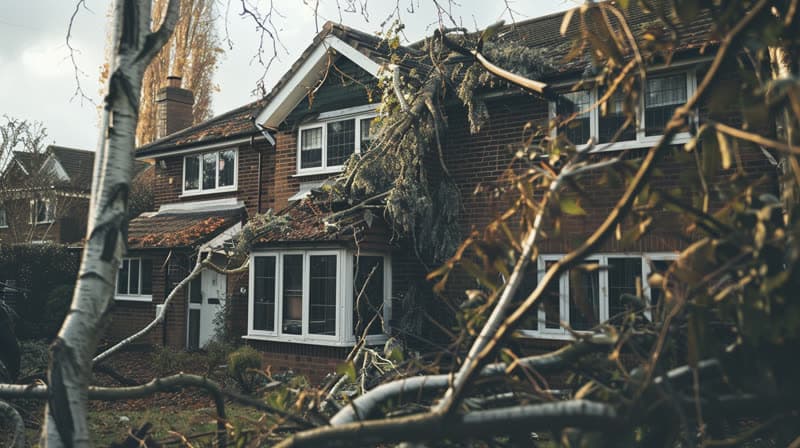
Autumn and winter bring a particular kind of property damage. A gale brings a tree down onto a roof. A car loses grip on a wet bend and ends up through a garden wall. A chimney pot from next door lands on the conservatory. Most homeowners have never made a claim like it.
These events generally fall under impact damage, meaning something physically striking your property. This guide covers how these claims usually run and the points that cause friction. For the full detail of what we handle, see our impact damage insurance claim page.
Impact damage covers more than vehicle collisions
On our impact damage page we group these claims into vehicle collisions with walls and buildings, fallen trees and branches, falling objects such as satellite dishes, chimney pots and roof tiles, aircraft and drone strikes, accidental impact, and damage caused by third parties such as contractors or delivery vehicles.
Which part of your policy responds depends on the cause and the wording. A tree brought down in a gale may fall under the storm section, a van through the front wall under impact, and something heavy dropped through a floor only under accidental damage cover, which is often an optional extra. Insurers define these terms differently, so check your own policy wording.
Fallen tree and branch damage in autumn and winter storms
Trees are the seasonal driver of these claims. Wet ground and the first gales of the season are a poor combination, and the damage can be extensive, including water getting in through the opening the tree has made, so a roof claim can quickly become an internal one too.
Fences and gates are the first surprise. The Association of British Insurers (ABI) says storm damage to fences, hedges and gates is generally not covered by standard buildings policies, so a fence flattened by wind alone may sit outside the claim. Where a falling tree or a vehicle has struck a wall or fence, the cause is different, so check how your policy treats that.
Tree removal is the second. Removing the tree and clearing debris can form part of the claim where the policy covers it, but cover and limits vary. Keep the tree surgeon's quote and invoice either way.
The third is whose tree it was. If it came from next door, the ABI's advice is to contact the tree's owner, but your own insurer is still the call to make as soon as reasonably possible. Our guide to storm damage claims covers the wind and rain side.
If the insurer suggests the tree was dead or decayed and should have been dealt with earlier, that is a maintenance argument, one of the grounds covered in why home insurance claims get rejected, and it is arguable on the evidence.
Vehicle impact damage to walls and houses
Cars, vans and lorries colliding with boundary walls, garden walls and buildings are among the most common causes of impact damage to homes, and wet leaves and the first ice of the year make winter roads less forgiving.
The driver has legal duties here. Under rule 286 of the Highway Code, which reflects section 170 of the Road Traffic Act 1988, a driver involved in a collision that damages property must stop and give their name, address and vehicle registration to anyone with reasonable grounds to ask. If they do not, they must report it to the police as soon as reasonably practicable and in any case within 24 hours. Take the driver's details if you can, and if the driver has gone, report it to the police yourself. A police report strengthens your claim and may be needed for a claim against the driver's insurer.
That gives you two routes. Third party motor insurance is the legal minimum for driving on UK roads and covers damage to other people's property, so the driver's insurer is one option. Your own home insurance is the other, and it is often faster and more straightforward. If the driver was uninsured or cannot be traced, gov.uk says you may be able to claim from the Motor Insurers' Bureau.
Hidden structural damage after an impact
A heavy impact can leave problems that only show later: internal cracks appearing days or weeks afterwards, window and door frames knocked out of line, damaged cavity wall ties, and fractured water mains or drains below ground.
Damage nobody has found cannot be included in the claim. We arrange independent structural surveys so hidden damage is documented as part of the structural damage claim. In the meantime, photograph and date any new crack you notice.
Making the property safe without weakening the claim
If anyone is hurt or the building feels unsafe, call the emergency services first.
After that, the ABI's guidance is to carry out emergency or temporary repairs only if it is safe and you have spoken to your insurer, and to keep photos, itemised invoices and receipts so they can form part of the claim. Photograph the damage from several angles, including the tree or vehicle, before anything is moved. Where the impact has left a hole in a wall or a broken window, emergency boarding up secures the property against further damage and unauthorised access.
If the house cannot be lived in during repairs, the ABI says buildings and contents policies normally cover the reasonable cost of temporary alternative accommodation, up to the policy limit. Professional fees for structural engineers and surveyors are worth checking for too. Our guide on how to claim on your home insurance covers the other early steps.
Disputed impact damage claims and how they are resolved
Insurers sometimes argue that damage was pre-existing wear and tear rather than the impact itself, and the scope of repairs can be contested too. If your insurer turns down all or part of the claim, ask for the reason in writing, with the policy term it relies on, and use the insurer's complaints process. The Financial Ombudsman Service says a business usually has up to eight weeks to consider a complaint, and if you are unhappy with its final response you have six months from the date on that response to take the complaint to the ombudsman, whose service is free.
Getting help with an impact damage claim
We are loss assessors working for the policyholder, not the insurer, and our page on loss assessors and loss adjusters explains the difference. On an impact damage claim we begin within 24 hours of instruction, advise on whether to claim on your own policy or the third party's, arrange independent structural surveys, and handle the insurer and their loss adjuster for you. Your initial consultation and property assessment are free, there is no upfront fee, and our claims process sets out each stage.
If a tree, a vehicle or something heavier has hit your home this autumn, get in touch and we will talk you through it.
This article is general information about how home insurance claims work in the UK. It is not advice on your individual claim, which will turn on your own policy wording and circumstances. For advice on your situation, speak to our team.