
Storm Boelo was the second named storm of the 2026/27 season. The Met Office named it on 22 October, and it came through on 24 and 25 October, only days after Storm Austen. If your home was caught, the repairs may still be going on, and some storm damage only shows itself weeks later.
This guide is about the claim that follows: how insurers and the Financial Ombudsman Service decide whether damage counts as storm damage, the wear and tear argument that comes up so often, and what to do in the first days. For the full detail of what we handle, see our page on storm damage insurance claims.
How the ombudsman tests a storm damage claim
Most buildings policies cover storm damage, but how they define a storm varies, so check your wording. Where a policy does not define it, the Financial Ombudsman Service says a storm generally involves violent winds, usually with rain, hail or snow. Heavy rain, hail or snow over a short period can count on its own.
When a storm claim has been turned down and the complaint reaches the ombudsman, it asks three questions:
- Were there storm conditions on or around the date the damage is said to have happened?
- Is the damage consistent with what is generally seen as storm damage?
- Were the storm conditions the main cause of the damage, or might it have happened anyway because of other factors?
It helps to build your claim around the same three questions from the start, because your insurer is likely to be asking them too.
Weather evidence for the date of the storm
The first question is about the weather, and a named storm helps. The ombudsman says Met Office naming is a good indication of storm conditions, but it still checks weather records, using historic weather data and readings from local weather stations, which can be a few miles from the property.
So note the date and, if you can, the time the damage happened, and keep any weather warnings that covered your area. If you only found the damage later, write down when you found it and what the weather had been doing. We use weather data alongside the physical evidence when we put a storm claim together.
Damage that looks like storm damage
The second question is whether the damage fits. Wind tends to lift and strip: tiles and ridge tiles, flashing, chimney pots, sections of outer brickwork, guttering and downpipes. Rain then gets in through the openings and damages ceilings, walls, insulation and electrics.
Some of that only shows weeks later, as staining or damp spreads. Report it to your insurer as soon as you find it, even if you have already made the claim. Damage from fallen trees, fences and vehicles has its own complications, which we cover in impact damage claims.
The wear and tear argument on storm claims
The third question is where most disputes sit. Insurers often argue that the storm only exposed a roof or wall that was already failing, and that the real cause was wear and tear, gradual deterioration or poor maintenance, which policies usually exclude.
The ombudsman's approach gives you some footing here. It says the insurer has to show that an exclusion applies, and that a property being in poor condition will not necessarily mean the damage was caused by wear and tear. It is, however, unlikely to uphold a complaint where the storm merely highlighted a problem that was already there.
That is why independent evidence matters. A structural assessment of how the damage happened, set against the weather records, gives the claim something solid to stand on. If your insurer turns down all or part of the claim, ask for the reason in writing, with the policy term it relies on, and use its complaints process. Our guide on why home insurance claims get rejected covers maintenance arguments in more depth.
What to do in the first days after storm damage
- Stay safe. Do not climb onto a damaged roof or go into rooms where a ceiling may come down. If the structure feels unsafe, keep out until it has been checked.
- Photograph before anything is cleared. Take wide shots and close-ups of every area, inside and out, before debris is moved or any temporary repair goes on.
- Prevent further damage where it is safe. Insurers expect reasonable steps, such as a tarpaulin over an exposed roof or buckets under a leak. Speak to your insurer before emergency or temporary repairs where you can, and keep the itemised invoices and receipts.
- Report it promptly. You do not need a full list of damage to notify your insurer. Tell them a storm has damaged the property and build the detail afterwards.
- Keep the debris until it has been seen, where it is safe to leave it. Fallen brick or tiles show what came off and from where.
After a big storm, many properties need repairs at once and contractors get booked up, so expect some delay and keep your insurer updated on what you have done.
A storm claim we're handling in Newcastle
One of the homes Storm Boelo caught that weekend is a rented house in Newcastle, managed by our partners at HM Residential.
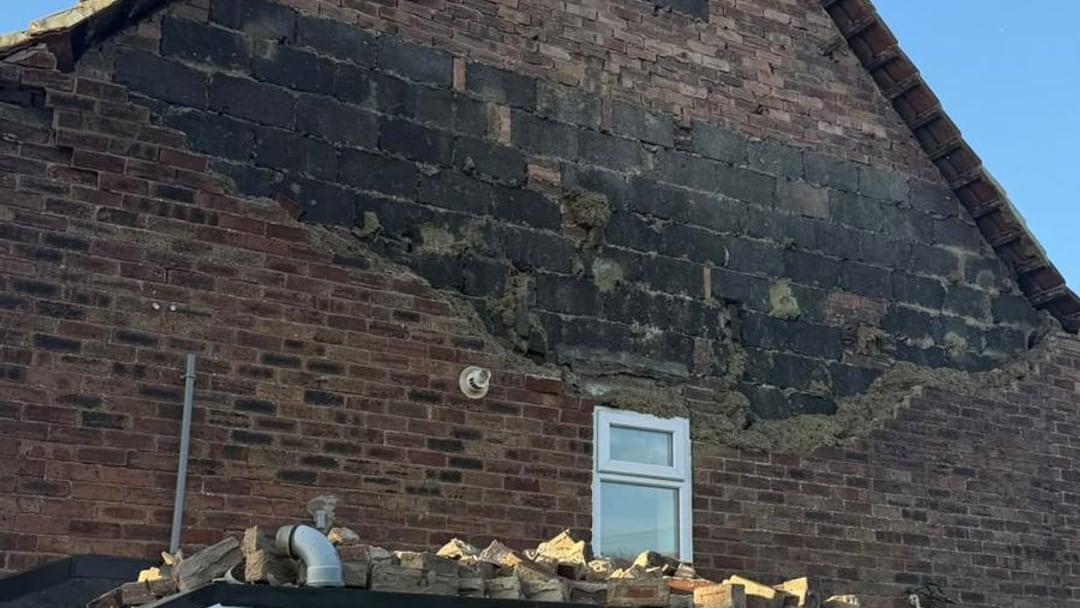
The wind took the brick off the top of the gable and dropped it on the bins, the extension roof and the garden. The photo at the top of this page shows the gable as it was left, with the blockwork behind exposed. Inside, there is cracking round the window frames that needs looking at properly before anyone puts a figure on the claim.
We are handling the claim from here: dealing with the insurer, building the evidence and overseeing the reinstatement. The claim is ongoing.
It is a good example of why the first visit matters. The brick on the ground is obvious. The cracking inside is the kind of thing that gets missed, or argued about later, if nobody records it and has it properly investigated early on.
Getting help with a storm damage claim
We are loss assessors and we work for you, not the insurer. On a storm claim we carry out our own assessment, with an independent structural survey, weather data for the date, contractor estimates, photographic and video evidence, a contents inventory where needed and a review of your policy. We then deal with the insurer and their loss adjuster for you, and can help coordinate emergency contractors where they are needed.
We act for homeowners, landlords and business owners, and we have a Newcastle office among our offices around the UK. Our claims process sets out each stage. If a storm has damaged your property this season, get in touch.
This article is general information about how home insurance claims work in the UK. It is not advice on your individual claim, which will turn on your own policy wording and circumstances. For advice on your situation, speak to our team.